
 Servicing All of Southeastern Wisconsin


Preparing Concrete Foundations for Early Midwest Freezes: Cold-Weather Pouring Best Practices
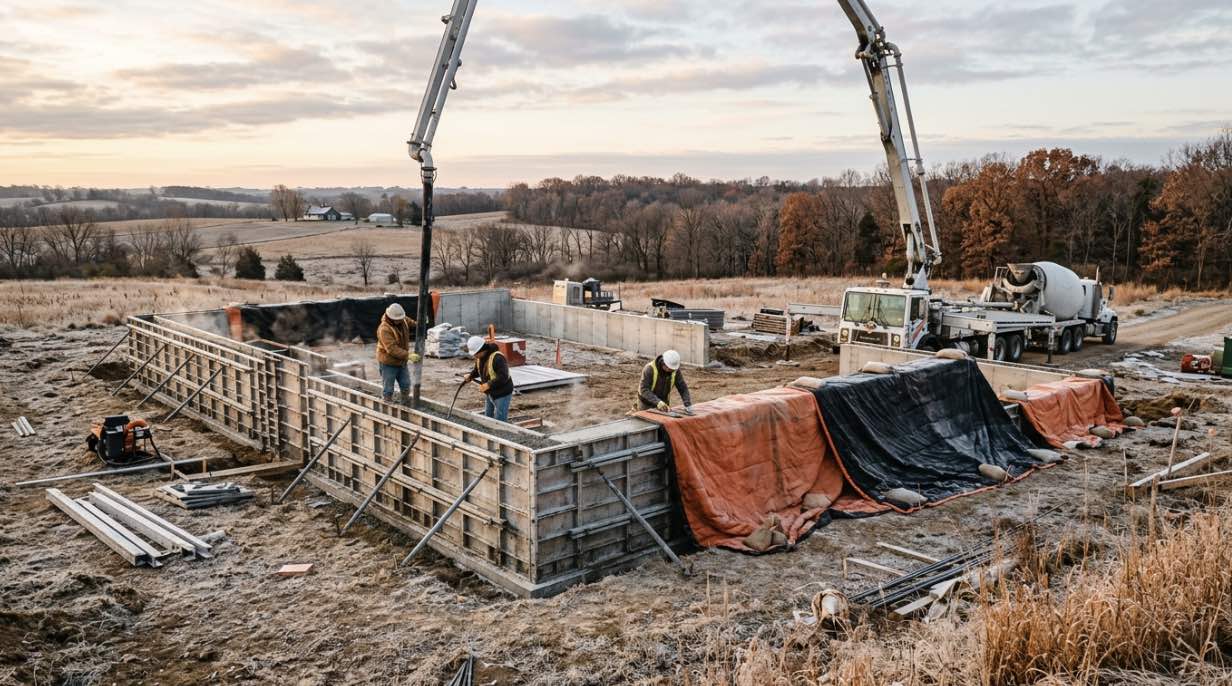
As autumn advances across Southeastern Wisconsin, foundation contractors know how fast a mild week can turn into an unexpected early freeze. Pouring concrete in cold weather presents unique challenges—from delayed set times to the risk of permanent structural damage if early-age concrete freezes.
When temperatures drop below 40°F, ambient conditions significantly slow down the hydration process. To keep your crews moving and protect your concrete investments, follow these essential cold-weather pouring best practices.
1. Never Pour on Frozen Subgrade
Pouring concrete over frozen ground is one of the most critical mistakes on a cold-weather job site. As the subgrade thaws under the warm concrete, it settles unevenly, causing severe cracking or structural failure in footings and slabs.
Prep the Ground: Use insulated curing blankets or ground heaters to thaw subsoil prior to placement.
Remove Ice and Snow: Clear all ice, standing water, and snow completely from forms, rebar, and footings before pumping.
2. Optimize Your Concrete Mix Design
Working closely with your ready-mix supplier during temperature drops ensures your mix can handle cold ambient conditions:
Accelerating Admixtures: Utilize non-chloride accelerators to speed up set times without risking rebar corrosion.
Higher Early-Strength Cement: Consider specifying Type III portland cement or increasing cement content to generate faster internal heat through hydration.
Warm Mix Water & Aggregates: Request heated mix water and aggregates from the batch plant to ensure the concrete arrives at the job site at an optimal placement temperature (ideally 55°F to 65°F).
3. Protect Your Wall Forms and Reinforcement
Cold steel and aluminum forms pull heat directly out of fresh concrete.
Pre-heat Forms: If temperatures are near freezing, keep wall forms covered or use heating enclosures prior to pouring.
Use Proper Release Agents: Choose a cold-weather formulated form release agent. Standard water-based release agents can freeze on the form face, causing adhesion issues, surface pitting, or difficult stripping.
4. Retain Heat with Insulated Curing Blankets
Concrete needs to reach a compressive strength of at least 500 psi before it is exposed to freezing temperatures. Maintaining moisture and heat during the initial 48-hour cure is critical.
Cover Promptly: Apply heavy-duty, multi-layer insulated concrete curing blankets immediately after finishing.
Secure the Edges: Pay extra attention to corners, exposed wall tops, and edges where heat escapes fastest. Weigh down blanket edges to prevent cold wind from sweeping underneath.
Monitor Core Temperatures: Use temperature sensors or thermal probes to ensure concrete surfaces stay above 50°F during the critical curing window.
Stock Up for Cold-Weather Success
Don't let an early cold front slow down your schedule or compromise your foundation quality. At Midwest Forms & Supply, we carry the field-tested supplies you need to keep pouring safely all season long:
- Insulated Concrete Curing Blankets
- Cold-Weather Form Release Agents
- Rebar, Wire Mesh, and Structural Hardware
- Poly Sheeting & Job Site Protection
Need supplies on site in Southeast Wisconsin? Give us a call at 262-770-8705 to order your cold-weather curing essentials.
Date Posted: Wed, 11/11/2026 - 10:45
